
Sewer line repair in Westfield, IN
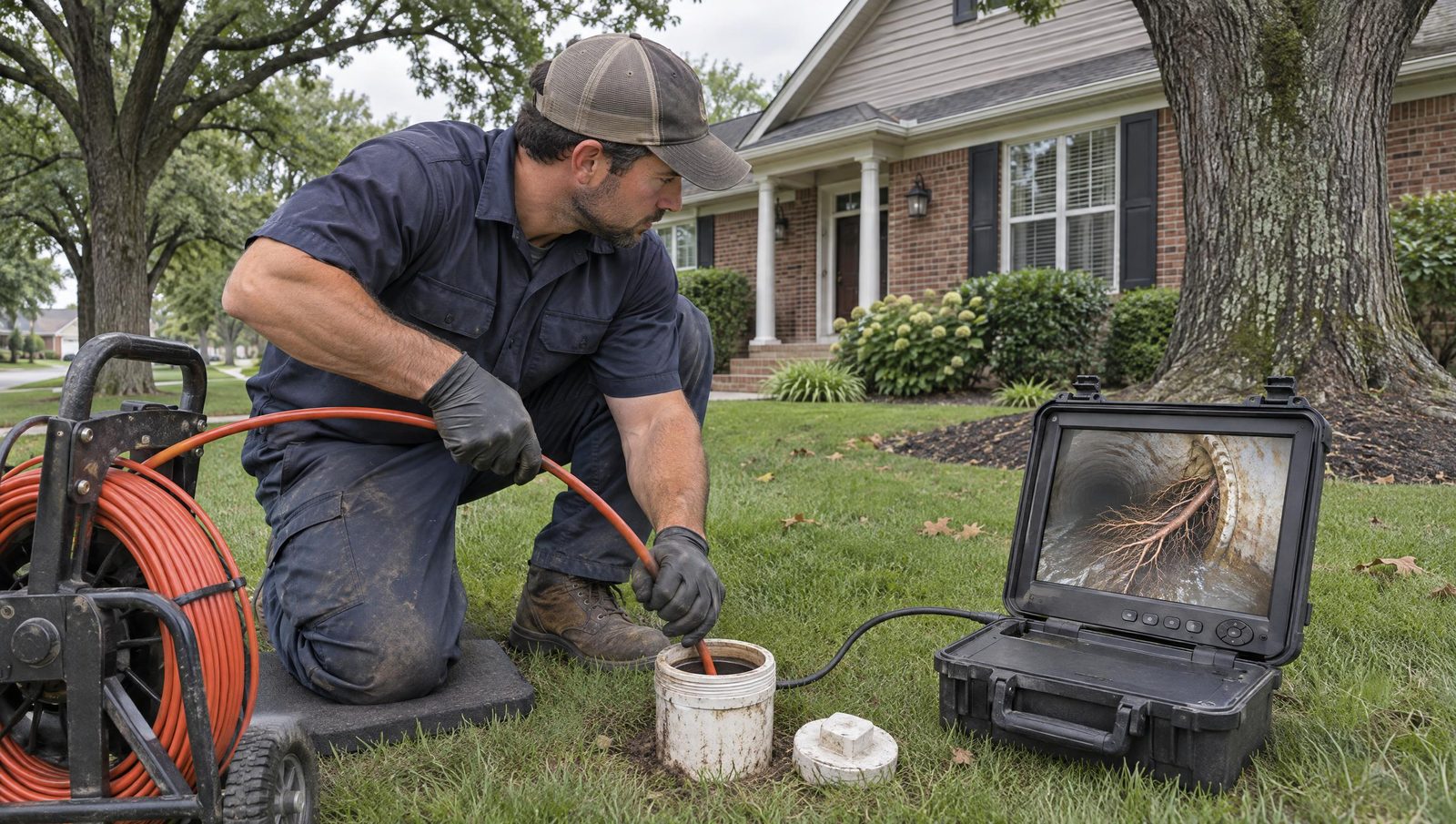
When every drain in the house is slow or sewage comes up through a floor drain, the problem is usually in the sewer line between the house and the street. We run a camera down it, show you the screen, and give you a written price for each option.
- You watch the camera
- Written options, not pressure
- Cleared first if it is backing up
Tell us what the drains are doing
We usually answer the same day, and the same hour for emergencies.
Water on the floor or a sewage backup? Call or text now: 317-555-0147
Sewage coming up, or every drain slow? Do this first
These steps keep the mess small until we get there.
Stop using water.
No flushing, laundry, dishwasher or showers. Everything you run ends up at the lowest drain.
Keep clear of the water.
Sewage carries bacteria. Keep children and pets away and do not wade in it.
Find the cleanout if you can.
A capped pipe in the basement or yard. It tells us where to start.
The camera inspection, and why you watch it
A sewer line is out of sight, so the only fair way to price a repair is to look inside it. We put the camera in through a cleanout and push it down the line while you watch the same screen we do.
The camera shows distance as it goes, so we can mark where each problem is in your yard. We save the video for you.
If the line is backing up, we clear it first so the camera can see. Then we give you a written price for each option, and you decide in your own time if it is not urgent.
“Every drain in the house was slow. He ran a camera down the sewer line, let me watch the roots on the screen, cleared it the same day and gave me a written price for the repair so I could decide later. No pressure at all.”
What the camera usually finds
Roots
Fine roots at a joint, or a mass that fills the pipe. Cut and cleared, then watched.
A belly
A sag where the ground settled and water sits. Waste collects there and clogs again.
Offset joints
Two sections that have shifted, leaving a lip that catches paper and roots.
Cracks and breaks
From age, roots or ground movement. Some can be lined; some need replacing.
Grease
A coat inside the pipe that narrows it. Hydro jetting clears it.
Objects
Wipes, toys and the odd tool. Usually removable without digging.
Repair options, side by side
| Option | When it fits | What to know |
|---|---|---|
| Cable clearing | Roots or a soft blockage in a sound pipe | Quick, but roots grow back; plan to clear again |
| Hydro jetting | Grease or heavy root growth | Scours the pipe wall; needs a pipe in fair shape |
| Spot repair | One damaged section | Dig at that spot only, using the camera distance |
| Trenchless lining | A cracked line that still holds its shape | A new liner inside the old pipe; not for a collapsed line |
| Section replacement | A collapse or a bad belly | Dig and relay the pipe at the right fall |
Sewer lines around Westfield
We work from Westfield and cover Carmel, Noblesville, Fishers, Zionsville and Cicero. See every town on the areas we serve.
Older neighborhoods
Mature trees and older pipe mean more roots. We see this most in established streets.
Newer subdivisions
Plastic pipe resists roots, but settling can still leave bellies and offsets.
You deal with Callum, and you keep the video

Callum Reid, owner and plumber
Callum answers the phone, tests the water and writes the price. You deal with him from the first call to the cleanup.
Book a camera inspection
We usually answer the same day, and the same hour for emergencies.
Water on the floor or a sewage backup? Call or text now: 317-555-0147
Sewer line questions
Who is responsible for the sewer line, me or the city?
Usually the homeowner owns the line from the house to where it joins the public sewer, and the sewer utility owns the main. Where exactly that line falls depends on your utility. In Fishers that is Fishers Utilities; in Zionsville it can be the Town, TriCo or Whitestown depending on the area. We tell you what we see and where it is.
What does a sewer camera inspection show?
A small waterproof camera on a cable goes into the line through a cleanout. It shows roots, cracks, separated joints, sags where water sits, grease and objects, and it tells us how far from the house each one is.
Why do roots get into sewer lines?
Roots follow moisture to joints in older pipe, especially clay and older cast iron, and grow in through the smallest gap. Mature trees near the line make it more likely, which is why we see it in older neighborhoods such as the village in Zionsville.
Do you always have to dig?
Not always. Roots can be cut out with a cable and cleared again later. Some damaged lines can be lined from inside, a trenchless repair, where the pipe shape allows it. A collapsed or badly sagging section usually has to be dug and replaced. We explain which applies to your line.
What if I am on a septic system?
We inspect and repair the line from the house to the tank. Pumping and work on the tank itself are for a septic contractor, and we say so if that is where the problem is. See our Cicero page.
Every drain slow? Let us look inside the line.
Tell us how long it has been happening and whether water has come up anywhere.
Book a plumber with a free hardness test
We usually answer the same day, and the same hour for emergencies.
Water on the floor or a sewage backup? Call or text now: 317-555-0147